
INDIANAPOLIS — Driving an NTT INDYCAR SERIES machine is one of the more harder things to do in all of motorsports. You’re traveling at speeds in excess of 230 mph at a place like the Indianapolis Motor Speedway and doing so without the aid of power steering. They’ll also do so without the aid of a rear-view mirror.
An INDYCAR is nothing like a streetcar and while they do have two small mirrors on either side of the cockpit, they’re also so much smaller that you truly don’t utilize them like a normal mirror would. With traveling at the speeds that they do, the vibration makes the visibility in those mirrors rather difficult.
On a track that drivers make plenty of passes on, including late maneuvers in a draft into the corners, drivers rely on spotters here more times than at any other track. It’s such a big responsibility, that two spotters are required here.
The spotters are these drivers’ eyes in the sky. They have to have as much trust in their spotter as they would with any other human being in their lives. You have to trust your spotter when they tell you someone is coming, or something is looking or if you’re clear around you to make moves and cover a line. One comment with bad information and it could be dire.
That’s why the spotters are arguably one of the most important pieces to a race team because of this.
In saying that, there’s also varying degrees of approaches that each driver-spotter combination operate off of. Some drivers like a lot of information.
“I enjoy a lot of information,” Scott McLaughlin said. “My guys they speak to me all the time. Adam Fournier is in Turn 1 and John Bouslog is in Turn 3 and they’re the same guys I had last year. But, Adam has been my spotter ever since I’ve been in IndyCar and he’s only spotter that I’ve really ever had. He knows what I need. The only word I hate listening to is ‘looking.’ I hate that word. He knows..”
His teammate, Josef Newgarden, agrees. He likes as much information as they can tell him. However, at some point, too much information becomes just that, too much. Newgarden balances ways to decipher at 230 mph at what he needs to know and what he doesn’t.
“I like more than less,” Newgarden told me. “Typically, if I don’t need it, I just tune it out. But I’d rather have it at my disposal. I want it to be useful information. I don’t like, you know, some guys like just chatter. I don’t like chatter I want good, usable information and the more the better. And I’ll use what I need at the time.”
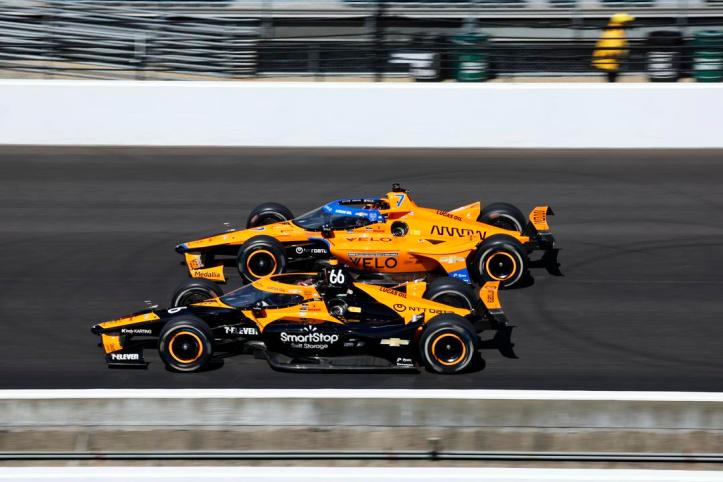
Tony Kanaan and Alexander Rossi on the other hand, don’t want to be bothered.
“Like tell me if it’s a crash,” Kanaan said. “That’s all I need to know. I don’t like people talking to me. I mean my spotters and all that but that’s just me. It’s not a good thing or a bad thing. It’s just a preference.”
Second place starter, Rinus VeeKay, told me that he’s more like Newgarden in a sense ethat he can filter things out pretty well. So he prefers to have more than less but can filter out what doesn’t mean much either.
There are times though when he likes to just be left alone and quiet for a while too so he can talk to himself and concentrate.
Simon Pagenaud and his spotter work in a different way. He likes to know what the competition is doing and who is where and doing what.
“It’s interesting, you ask that question. I like a lot of info on the competition, like a lot of info on positioning,” he told me.
He also said while that’s nice to have, it does get distracting when his car starting having handling issues and he needs to concentrate more on keeping the car from stepping out from under him than dealing with voices in his head.
“But sometimes it gets overwhelming especially when you start having a handling issue,” he continued. “That’s when things need to get quieter because you need to focus more and it’s very difficult to focus on two things at once. Which the brain doesn’t work that way.”
Still, he says it’s very useful and his 2019 win, his spotter was a key element to doing so and he loves that relationship.
Pagenaud had a great relationship with his spotter from his SPM and Penske days. They were dialed in and perfect for what each other needed. With the new spotter, it’s still learning each other and finding out what needs to be said and what doesn’t. Still, he says it works well for him.
Jack Harvey is another one that doesn’t want people just talking to him all the time because, he says he can go better still and can still see what’s going on.
“However, I think I’d rather have too much information and try and filter out that too little information gets you out of the race and relay out, “he told me. One of his spotters is new while the other has been with him for a while so they balance each other out well.
“Yeah, we’ve been talking about that,” Harvey said on if he wants to know the strategy calls behind the scenes on the pit box. “Like I think I need more of that info to be able to at least give my two cents from the car and I think that’s what’s different sometimes like people watch TV and they can see a bigger picture of the race. I think having that little extra communication between me and the team with what they’re thinking. Maybe you totally agree that maybe disagree with it. Maybe they still do it either way, but at least you just you understand how the race is shaping up better.”
The other aspect is the influx of European drivers over here. They don’t use spotters overseas. So, when they come here, that’s definitely a learning experience to have someone in their ears talking to them during a race.
“Never had a spotter before my entire life,” said Christian Lundgaard. “Because we don’t use it in Europe and you’re okay. It’s not even a known thing. So coming over here I think I had a spotter at St. Pete for the pit exit and I was like who is this guy? Radio? But, I needed them for the ovals 100%. I think the racing will not work out with our spotters. So I’m very happy with them.”
Marcus Ericsson had a similar experience in 2019.
“Yeah, it took a bit of time to build that trust for sure,” he told me. “Because yeah, growing up in Europe and racing in Europe all my life, it was I never had a spotter. It definitely took a while to learn to trust them, you know, but when you get that trust builds up, it’s definitely a help out there.”
Ericsson says it’s a different situation on if he wants a lot of information or not. He likes to get it, but sometimes it can get overwhelming.
“Yeah, it’s difficult,” he says “You know, I like to get information, but it can get too much as well. But I worked with Mark and Chad as my spotters here for a few years now. And you know, we sort of build up understanding on how much information I need and that they need to be my eyes and in my in my rearview mirror but also helped me you know, if they see stuff on the track if they see someone running some different lines and that seems to be working, you know, not maybe as much here but on you know, Texas, Iowa and these places it’s good to get the spotter to help you out if they see someone riding the highline and stuff like that.”
On Sunday, in a race to where all the drivers say that you don’t want to be leading coming to the final lap, the spotters coming to the checkered flag may end up being the MVP in this entire operation.
 Race Review Online