
INDIANAPOLIS — Indianapolis and innovation go hand in hand. While Daytona (Ormond Beach) claims to be the birthplace of speed, Indianapolis is the true home to car innovation. This week, the NTT INDYCAR SERIES and their manufactures Honda and Chevrolet, brought two cars a piece to the Indianapolis Motor Speedway in order to conduct the next wave of innovation that will debut in the series next season.
Next year will be the first in the long-anticipated move to hybrid power. While this was initially supposed to be a 2.4-liter engine, INDYCAR hit the pause button to allow the innovative hybrid technology to be paired with the proven 2.2-liter twin-turbocharged V-6 engines.
They’ve been developing this formula all season and have conducted a series of tests on road courses as well as Sebring to simulate the feel on what’s most similar to a street circuit. However, they’ve not yet been able to test this on a superspeedway.
Until this week.
Thursday saw Colton Herta and Alex Palou test the two Honda cars with Will Power and Alexander Rossi on the Chevrolet side. The morning session was each driver getting acclimated to the new technology. The afternoon part was for group running.
They came back Friday to do it again. This time, Marcus Ericsson took the wheel for Andretti Autosport in favor of Herta and on the Chevy side, David Malukas hopped in for Rossi who had to leave for his upcoming wedding this weekend.
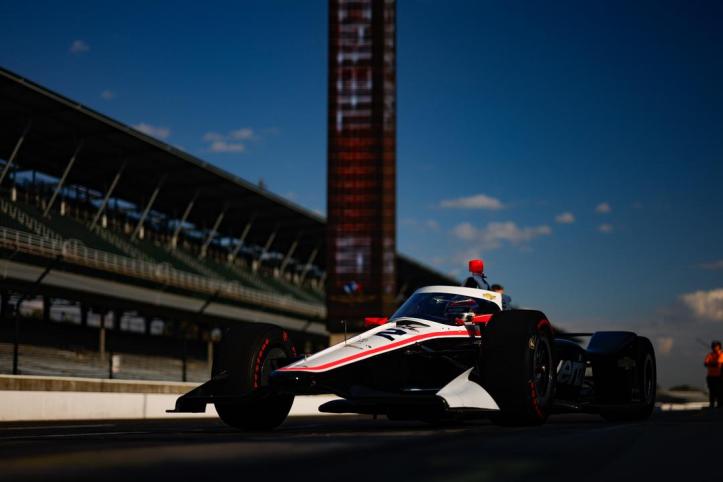
Power and Palou were the mainstays and rightfully so too. Power’s teammates Josef Newgarden and Scott McLaughlin are down in Road Atlanta competing in the IMSA season finale but also, Power (2022 champion) and Palou (2021, 2023 champion) have combined to win the last three series championships too.
“I start to think that it might be good enough for making the racing even a little bit better, especially on traffic here,” Palou said on Thursday of this new technology. “It’s a complete different thing. It doesn’t look like that from the outside, but it’s actually a lot of things that the driver needs to think and stuff. I never had to think about regen at IMS.”
What this new technology is doing is getting up to speed with the times. They way the current engine fit into the 2023 car will do the same in 2024. What this means in laymen’s terms is the hybrid part has an MGU (motor generator unit) which is placed at the rear of the car. There’s a super capacitor which stores the energy which is housed in the gearbox. All this fits in the bell housing so structurally and shape wise, nothing looks different to the outside world.
But, how this works is, the hybrid unit provides up to an additional 150 horsepower when used. Think of it as like push to pass. When you brake, it regenerates. That’s why on road courses, they’re testing different methods on whether to automatically allow it to regenerate or to manually do it.
Which leads us to this week. A superspeedway is effectively different. You can’t just brake at Indy to get regeneration back. So how do you make it work?
That’s why we’re here. They’re testing out paddles on the cars to see if the drivers can regen themselves.
“We had paddles on the car already,” said Honda’s Matt Niles. “Using that for regen seemed like the natural thing to do.”
Niles said that they had to do some software trickery to reassign the clutch paddle for use while out on track but it seems like it could work.
Rob Buckner of Chevrolet agreed.
“When we were looking at how we could make this work as a superspeedway, the paddle was a fit for how the drivers could manage the energy in the system, out of the system,” he said. “Kind of plays into the hands of the driver with how this place historically races. Seems like a good starting point for first couple days here. I think we’re all learning a lot. There’s a lot of details to come on that, but all good so far.”
Which is why they’re doing this right by testing with single driver laps to get used to this and then turning them loose in a pack because there’s absolutely a strategy element to this new formula.
“It’s going to give the drivers a new toy, a new tool,” said Jay Frye. “Some of them are going to like it probably more than others, it’s going to be interesting to see how it plays out.
“Remember, three or four years ago, we ran a push to pass test here, so we’ve done something kind of similar to this. Never run anything like this on an oval before or anywhere before, an oval for sure. It will be interesting to see how this afternoon plays out. Again, it’s a new tool. We got amazing drivers and amazing teams, competitors, they’ll figure it out.”
The drivers agreed. They think it’s going to be another piece to what makes Indy special and we could get back to even more passing than we’ve already had because of this tool.
“The only issue I saw this morning is that obviously when you recharge on clean air, you lose a lot of speed,” Palou said. “You gain it back. If I recharge here, I’m losing a ton, then I gain it back there.
“When you are in traffic, we normally start let’s say coasting the start/finish line, I think it’s a moment which you recharge and hopefully if you’re in third you can still overtake.
“We need to see in traffic it might change. I think it’s actually going to be better here than in other places.
“If you’re leading, let’s say, you cannot regen. As soon as you regen, you’re going to get passed. If you’re second, you can regen a bit, but not too much. And the third, normally these past two years it’s just waiting. If you can regen aggressively and hopefully deploy aggressively as well, hopefully overtake and be from third to second, then have more movement, which is what we want.
“We want to be able to be in the pack, overtake slowly one by one, and have more chances, which I think we will be able to get that.”
That’s because if you’re first or second, eventually you’re going to have to regen. That’s naturally going to allow others behind to pass because they can push the paddle for that extra 150 or so horsepower and power themselves by. However, the cars that were passed which have already regenerated can pass those cars back because they will then have to regen again themselves.
“I think the timing is still going to be really critical,” Palou said. “Like, we don’t get the huge jump. I don’t think you could get a huge jump because it would actually be a big, big difference.
“Timing is still going to be I think more important than having the push to pass or deploying the hybrid system.
“I still have an automatic, really low regen, so at least the balance of the car, it’s consistent. But then to have, like, a big difference, Okay, I’m going to regen this lap, this couple of corners, so…
“Just to have something for the driver that we can make a difference, I think it’s what INDYCAR wants.”
Another layer to this is tires. With more horsepower leads to more load on the tires. You don’t want to wear the tires out too early in a run and as a result slide backwards.
“I think so,” Malukas told me on the tire part of the equation. “I mean, it kind of depends. I think we’ll see kind of the end of today once we start doing longer runs, being in traffic, seeing how it’s going to play out.
“It all depends on when you want to use that extra power. If you want to save the tire, use it on the straight, not through the corner. You’re kind of saving the tires.
“I think it all is going to be a bit of a play. We’ll see.”
Power, the 2018 Indy 500 champion, 100% agreed with both on strategy plays now.
“Yeah, well, as soon as you’re in the draft of someone, you’re going to be regenerating,” he says. “Then you’re going to be trying to time that deploy of what you want to pass. Maybe you’re not going to get him and switch off and regen again, wait for a better run.
“I think that will be really based on how you’re running. Yeah, I think you’ll try to keep that tank full. Instead of hitting the limiter or lifting, you’ll grab the paddle to regen. Yeah, it will just be a constant changing thing.”
In saying that, is this extra tool going to make drivers too busy inside of these cars.
“It’s already a lot of work trying to be on track, weight jacker, bars. Now you need to regen and deploy,” said Palou. “You still have the weight jacker and bars. It’s a lot of stuff that we’re adding, which hopefully it’s not too much.
“At the moment I feel good. Let’s see with traffic if it gets too much. But I think it’s super exciting even for the teams, drivers, that we get more stuff to play with. New things are always fun.”
His former Ganassi teammate agreed.
“I think the car itself, you don’t really feel a huge difference. Obviously it’s a bit more busy on the steering wheel,” said Ericsson. “On the oval you have the weight jacker, front and rear bar, now you have the regen and deploy as well. It’s getting busy in the cockpit. I think that’s the biggest thing. We’re still working on different things with how much regen and deploy. It’s still a process we’re going through.
“I think it’s exciting for the series. It’s a really cool new feature that we’re going to have. I’m hoping it’s going to be a way where you can as a driver be smarter than your competitors and do it better than your competitors. That for me excites me with the whole system. As it seems, it’s going to be quite manual. I think that will be really cool.”
Power said this is pretty straightforward. “You pull the paddle, you press a button,” he said. However, he does think it will make you busier in the cockpit, especially during qualifying.
“I have to say, like, in qualifying, you’re going to be pretty busy on that first lap,” Power said. “Pretty sure you regen on that lap, decide when you deploy. Between that, the weight jacker, switching the fuel slot, and the bars, yeah, pretty busy qualifying.
“It’s, yeah, part of the game, another tool that you’ve got to be good at, pretty smart with the way you use it.”
Speaking of qualifying, as the pole record has fallen in each of the last two years with four-lap averages getting into the 234 mph barrier, the drivers don’t think that a track record of 236 mph+ is coming next May.
While this adds extra weight, there have been other weight saving measures taking place too including a lighter Aeroscreen. So while this balances out, this technology won’t be any faster…yet.
“No, it’s certainly not faster,” Rossi said. Power, the all-time pole record holder agreed.
“No, not next year it won’t,” he said of high speeds with the more horsepower. “It’s got more capability, but I think reliability comes first. Creep up on the amount of power that we use and deploy.”
This technology at the moment is a spec item in order to help teams not push the limits and risk attrition and expense that they don’t need. But, by using the regen, it puts the onus in the drivers’ hands.
“It’s going to be a spec piece at this point, yes,’ Frye confirmed. “The drivers will have a tool that they can use differently. I think that will be something that will separate, How does that work for the drivers.”
The manufacturers are 100% good with that.
“Yeah, I mean, we’re still trying to get more power, squeeze more that we can out of that every year,” Buckner said. “Then, yeah, I mean, it’s a new piece, a new bit of energy. So even though we kind of all have the same system, there is some differences in how you might use it, how a driver might interface with it. Our engineers are able to sort of dig into that and try to figure out the best way to go forward.”
 Race Review Online