
INDIANAPOLIS — Michael McDowell apologized for thinking that he made Sunday’s Verizon 200 boring for them.
“I’m sorry that it was a boring race for the fans,” he boasted.
However, while some may say the third iteration of NASCAR’s foray onto the 2.439-mile Indianapolis Motor Speedway was lacking, I feel like they’re watching the wrong things if so. This race was expected. I even said so before.
Strategy was going to be in play because NASCAR did away with stage breaks. While the stages would still count for points, the race would continue on without a stoppage. A road course like Indy, well there was a potential to drivers to settle in and race the right way.
That’s why we saw just one caution early. It was for only three laps. The final 77 laps ran green. No overtimes. No BS late race maneuvers on restarts. Just a pure proper race with plenty of passing, clean passing, respectful racing and the right guy winning.
What more could you want?
“Yeah, I mean, you’re going you go back to I mean, really pitting the race backwards,” Ryan Blaney told me on Saturday morning. “I think you can do this race in two stops. There was kind of a mixture of two stops last year and three stops.
“So yeah, I mean it just changed it you know, it’s back to the old form before the stage breaks. So if you can pit it backwards and the fastest cars are really going to show up, you know, because before when he had stage races in the you know, those the fastest cars, they would obviously probably flip the stage trying to set themselves up for the end and if you were a little bit off the pace, you could stay out try to get some stage points and then reacted from there.
“So that’s, you know, that’s just changed. So it benefits faster cars, which is good. So more traditional what it used to be not too long ago but you know, six, seven years ago.”
That’s the right race. The faster car should win.
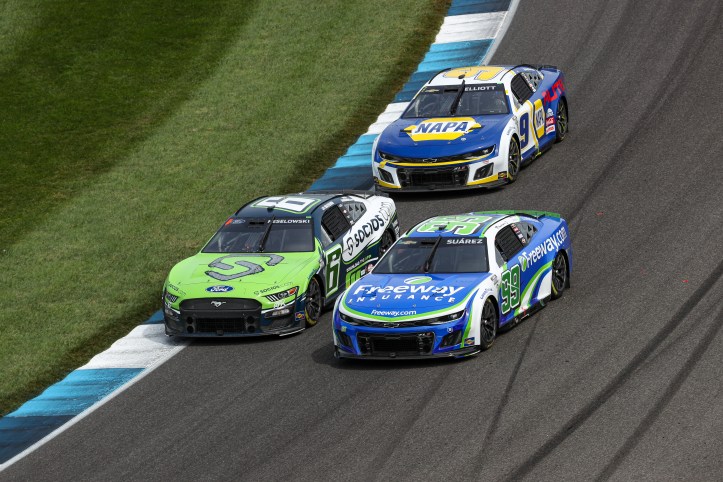
AJ Allmendinger also said that it also will help the faster cars as well too.
“I mean, I think at the end of the day, you still got to be fast enough to run up front,” he told me. “It does you no good to get up front and not be fast enough and get past by everybody anyway, so you know, it’s people are still going to pit when they think it’s right.”
Michael McDowell was fast enough to run up front. We knew that on Saturday.
“Yesterday was just different. When I unloaded yesterday, I felt like, yeah, we’re going to be contenders,” he said.
“If you just look at practice, we were the fastest in practice, fastest five lap, fastest ten lap, fastest average, and I woke up this morning nervous. I really did. I don’t normally wake up nervous. I was anxious, feeling like, I think I have a race-winning car here, and I’ve just got to go do my job and not look like an idiot.”
Between strategies of some drivers pitting early for a three stopper, others on a two stop strategy and racing throughout the field, I can’t think of time that this race on Sunday didn’t deliver something.
“We did expect it. We were hopeful for it,” McDowell admitted on Sunday being a clean race. “We really were because we knew we had a good long run car. Without having the stage breaks, there’s the potential for that. We saw it at Sonoma, too, minus a late-race caution. But that thing was going to go green the whole time, too.
“So it’s like capitalizing on opportunities. We knew this year that no stages was going to create opportunities for us because we’ve always had to be in a must-win situation, and so we’ve never taken stage points at the road courses. We’ve always pitted with two laps to go because we need the track position, we need to put ourselves in position to win.
“We were always racing track position with the stage breaks.
“We knew this year out of all the years that if we just had a fast car, execute, we’re going to run so much better than we would with the stage breaks because even today it was a perfect example of you can build a lead, and when you pit, you’re not going to lose five spots if you have a hiccup. You’re going to lose one because you built a three- or four-second lead over the car behind you.
“We knew there was a lot of opportunities without stage breaks, and with this running as green as it did today, it played into our wheelhouse for sure.”
Joe Gibbs Racing driver Denny Hamlin said earlier this year that he has some concerns about doing away with the stage breaks. He said that he expected the race to be more physically challenging without the scheduled opportunity to pit.
“I think this thing has the potential of really getting strung out, a lot” Hamlin said. “If we do, I don’t want to hear any complaining because that’s the potential. … this will make for more strategy though.”
Boy was he right.
Just one caution for three laps occurred. 79 of the 82 laps ran clean and green. By comparison, the first year saw 6 cautions for 25 laps. 2022 had 5 for 15.
73.6% of the inaugural race was run under green flag conditions. That upped to 82.5% last year. This weekend, it was 96.3%.
Fans aren’t going to like how this race looked. I do. I felt like the best car and the best driver won. It wasn’t a fluke. It wasn’t a comedy of errors in the end. It was a pure race.
NASCAR started this stage format in 2017 as it rewards points for the top 10 finishers of the two stages. It’s done to make the drivers actually race from the onset of the green flag but also give fans a break to go to the bathroom or concession stand or if you’re at home, to walk away from the TV at the two stoppages.
However, most fans didn’t take to it like NASCAR thought they would. Many fans liked the idea of stages, but why not just continue on with the green flag action? Award points and if the flag was a green checkered like it was, doesn’t green mean, go?
Hence the change.
It was becoming the norm for teams to elect to pit right before the stage would end to give up points for track position. They don’t have that luxury anymore. They automatically knew when two cautions would fly so would plan accordingly. It took the strategy aspect out of these races.
I now like that strategy plays are back in the hands of the teams again and that these races won’t carry on forever. You now don’t know when cautions are coming and can open up when to pit and when not to do so.
Blaney said he’s a fan of this move.
“You know, it just flips the whole field and I think it can get pretty difficult so I think the way to do it here on all road courses is the right way to do it,” he continued. “You know, have your have your stage points, but don’t throw the yellow because I think it makes more sense that way.”
 Race Review Online