
Weather
Nashville is already treacherous enough, but add rain to the mix, watch out.
Our eyes will be towards the sky on Sunday as there’s a potential for some wet weather. As far as how much and when, well that’s up for debate. Which is why rain could play a massive role in how Sunday’s race looks.
Does it rain before the 12:30 p.m. ET green flag making the NTT INDYCAR SERIES declare this a wet start? If so, the strategy of having to use at least one set of primary as well as alternate tires is gone.
If it rains before but not during and the track dries naturally, then who pits for what tire is going to be a factor in who wins this race. Also, when they pit for slicks is too because if you pit too early, you could lose a ton of time by tip toeing around. Pit too late, you’re a lame duck. There’s a sweet spot to be had.
Then there’s the issue of what if it doesn’t rain before the race but does during. That sets up a scenario of when to pit for wets and how long to stay on slicks is a factor.
Then there’s also the worst-case scenario of too much rain falling and causing puddling for which the cars can’t race on the track with that aspect and/or lightning in the area for which also brings out a stoppage.
There’s also a possibility of this race going from green to checkered without any weather interruptions as well for which is why our eyes to the sky is something we’re watching.
“The most interesting thing is you never have a car that works in the wet and the dry,” said Colton Herta. “It’s just not possible.”
Points leader Alex Palou said it’s going to be a virtual unknown if it rains on Sunday because it’s not like they have much practice on wet tires. They had 1 session on Saturday but only for 30 minutes.
Palou said he’ll let the engineers decide the setup if it’s wet.
“I remember Indy GP last year where we started on wets. There were some cars that were a bit more set up for the wet conditions, and they were flying. But as soon as it dried, they started to get slower,” he noted.
The last wet race was that 2022 GMR Grand Prix. In that race, the drivers complained about the Aeroscreen in wet conditions. It was tough to see as some drivers made mention that the only way they could have a visual reference of where to drive was to look out the sides and not out front.
That’s because that the water accumulated on the Aeroscreen and stayed there on either wide of the center wicker that goes from the nose to the screen.
“I couldn’t see,” said Simon Pagenaud following his runner-up finish in the 2022 GMR Grand Prix. “I didn’t even know where he was, quite frankly. I picked a few points on the fence to know where I had to brake, but it was very difficult to see without the wiper.”
Will Power agreed. He said it was more about survival there in the end.
“At the end there, man, you could not see a thing. There was a spray in front of me. I don’t know how it was behind the one car, but just the two car, I couldn’t imagine being back in tenth, man.
“You don’t know if someone is braking early or you are kind of looking to the fence to get a reference, you kind of lift early. You don’t want to lift too early because no one can see from behind.”
Power said though that he didn’t have a lot of problems in the rain. It was when it was damp on his end.
“Actually, I didn’t have much problem with the rain,” Power continued. “The worst part for me was when it was half wet. We’re on drys, and you have kind of that gritty just dirt on top of water. That was when I struggled to see a little bit, but in the full wet, I mean, the biggest problem for me was the spray from the cars.
“There’s really nothing can you do about that with open-wheel cars. It’s just going to be a lot of spray. Honestly, it was on the edge of whether we should have been running right at the end there. It was starting to get a bit of aquaplane.”
Conor Daly said then that he had never seen anything like that before.
“It was like the water just stayed in the center of the screen, and I don’t know why, but even as you went faster, which you would hope it would clear, it didn’t,” he said.
He noted that the race then was very much a scientific test run and that they have enough data now to make adjustments because it was a challenging day.
He was grateful for his spotter who Daly said, “was literally guiding me into turn one. I couldn’t see the brake zone or the cars in front of me or the end of the pit wall, but I could look out the side of the Aeroscreen, so I was looking right and left to go straight, which was neat.
“I used to race in the rain all the time, so we had a visor that you can work with, but this is a new era, so obviously there are things that we can figure out. We go from here.
“I do think it was tough. It was definitely hard to race like that because you don’t want to, obviously, end up on the wrong side. Even under yellow. I couldn’t see the cars in front of me under yellow. I had to be guided into pit lane, and that’s concerning. Hopefully we can figure that out, but hopefully we also have very shiny weather for the rest of the year.”
As a result, INDYCAR made a mandatory safety addition of rain vanes to direct as much water as it possibly can away from Aeroscreen.
Will it work?
We may find out.
Coming into that race, there were 34 races with the Aeroscreen and none were affected by wet weather. There’s been 23 races since and no other rain races.
Does the Big Machine Music City Grand Prix join it on Sunday?

How The Race Will Look
The final Big Machine Music Grand Prix on this current layout will come to an end on Sunday. A race dubbed in “Crashville” has been the equivalent to INDYCAR for what the likes of Daytona or Talladega are to NASCAR. Why?
The series races also on the streets of St. Pete, Long Beach, Detroit and Toronto and none of their races look like this one.
The two races so far run on these city streets were messy ones. Out of the 160 combined race laps turned, 43% of them were under caution periods with 38% of the cars being loaded back on the haulers early after crashes.
The inaugural race saw 9 cautions for 33 laps. Last year’s was one less yellow (8) but more caution laps (36).
St. Pete this year had five cautions for 26 laps (26%) and last year one caution for eight laps (8%). Long Beach had just two cautions for seven laps (8%) this April and four for 14 (16.4%) last year. Detroit had seven cautions for 32 laps (32%) this year but last year on Belle Isle it was one caution but for no laps as it happened at the end. Toronto last year was four cautions for 15 laps (17.6%) and three for 16 laps (18.7%) last month.
Why is this one so vastly different?
A tight street course is customary no matter where you’re racing. St. Pete (1.8-miles) has slippery due to new paving, Long Beach (1.968-miles) is Long Beach, Detroit (2.5-miles) is just as tight and just as bumpy, if not worse, than Nashville while Toronto (1.786-miles) is your typical street circuit too.
Nashville is also bigger than 3 of the other four at 2.1-miles too, so why the carnage?

Is it due to the nature of this track. 10 cars were listed as DNF a year ago due to “contact” but more like upwards of 14 or more cars collected damage at some point during the race. A season low 15 cars saw the checkered flag.
“Other than that, it’s not terrible to have a crazy race every now and again,” noted Colton Herta. “And this might be INDYCAR, some of the races are snoozers and some of them are really amazing, and some of them are amazing for this reason, because there’s cars going off all the time, you never know who is going to win.”
Sloppy? Sure. Fun. Absolutely. The drivers liked it and hope the fans did too.
“Obviously, there was a lot of cautions and the red flag, and it’s not ideal, but I don’t know from a fan standpoint,” said Alex Palou.
“As long as they had fun watching it, it’s one of those things that I think the atmosphere here in Nashville and the race event itself, it’s amazing. So as long as the fans are happy, I think it’s good if we continue here.”
We all thought Detroit was going to be that way but proved otherwise. Can the drivers finally find a rhythm and sing the right tune in Nashville?
“I can’t,” Herta said on if this year will be any different than the first two years. “I don’t know if it will be. Yeah, obviously the first two races it caused a lot of chaos. INDYCAR is always trying to look for ways to make the racing better. They feel that this is a good way to do that.
“I’m hoping this new restart zone fixes a lot of the problems we’ve had in the past and it’s a little bit more of a normal race.
“You don’t want a full green flag race because that makes it stale for the racing. We definitely want to do better than eight or nine cautions than it has been the last few years.
“I’m hoping it works out. I’m not sure really if it will or it will not. I guess we’ll see.”
Rebounds
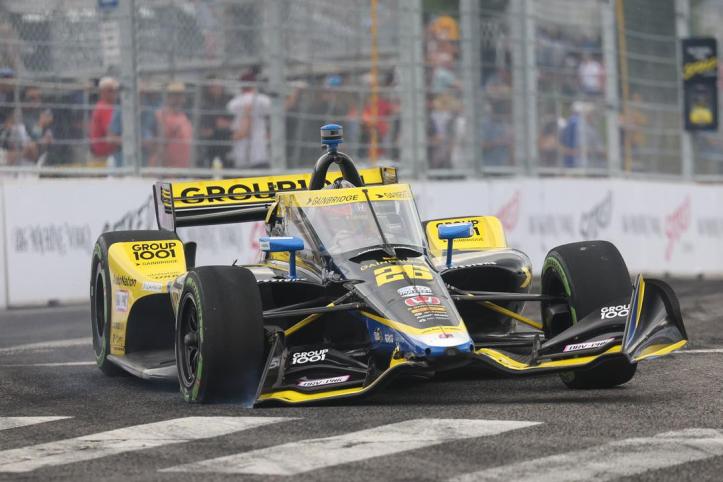
Starting position hasn’t mattered much here. In fact, this is a race that even with an early incident you can make up for it later.
Marcus Ericsson went airborne in the inaugural race on a Lap 5 crash. By Lap 33, he was leading. He’d win in the end.
Last year, Scott Dixon was collected in an early race crash too. He had to pit multiple times for repairs, restarted outside the top 20 and later wound up in victory lane in dramatic fashion.
The starting spots of both winners were 18th and 14th. Dixon pit 7 times a year ago and still landed in victory lane.
These aren’t the only success stories either.
Colton Herta and Alexander Rossi each rebounded from early race troubles to even falling a lap down to still finish in the top 5 last August.
Nashville is a race to where you need luck to win. Pure speed doesn’t necessarily win here. Both winners prove that. But you also can pass if you have a good car too though. 5 of the top 6 finishers last year rebounded from being outside the top 10 to finish there.
Qualifying hasn’t mattered here either.
Starting spot of Top 5 finishers in 2021: 18th, 2nd 10th, 14th, 13th
Starting spot of Top 5 finishers in 2022: 14th, 1st, 4th, 17th, 23rd
“I’m not really too sure. It seems like the fastest way to win this race is crash your car in the first lap, do six pit stops, then pit with six to go and stay out (smiling),” Herta said.
So, who has something occur early on because that may be your race winner later.
Pit Strategy
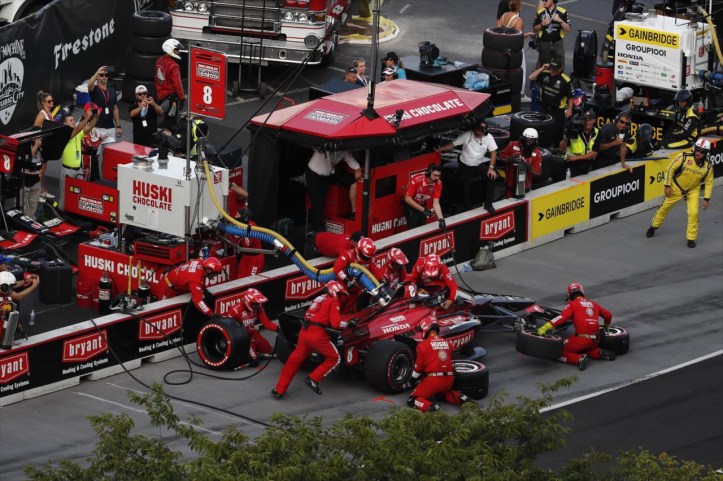
One thing that we will see on Sunday is the smoke coming out of the strategists ears on the pit stands trying to call this 80 lap affair.
“I don’t know. It’s a crazy one. Obviously it’s very different to any other race that we go to,” Colton Herta said. “But we always plan for the most normal race possible, then obviously strategies change. In this one, they really change.
“It’s hard to know what a good strategy and bad strategy is depending on what’s happening.”
I mean if you’re leading the race, you’re in constant fear that a caution could come out at any given moment and screw you. It’s unlike most other races to where you want to be leading and having control of how this race dictates. Here, you can’t.
“I mean, you’re just waiting for the yellow light to flash up on your dash or something like that,” Scott McLaughlin said. “You can’t control anything like that. It’s a matter of me controlling what I can control, execute.”
His teammate, Will Power agreed.
“Yeah, you would expect there’s going to be a yellow. Just expect it,” he said. “I mean, it’s unfortunate if you’re leading, but just know that’s going to be the deal.
“There’s just really nothing you can do. It’s just like luck of the draw when it’s like that, when it’s that crazy.
“Just one sort of yellow, yeah, you could try to play it safe. Man, you could start last and win it maybe the way it’s been easy. Maybe it goes completely normal. I thought that’s what would happen last year. Just didn’t. Surprised me. Just didn’t.”
McLaughlin starts on the pole for the second straight year and is hopeful this year’s race is more straightforward than last.
“I don’t know what will happen tomorrow. You can’t even plan really. Guy won last year doing six stops,” he said after scoring a mega pole by 3-tenths on Saturday.
“You just got to play it on the run and try and do the best job, execute every lap that I can. Pit stops need to be good. Yeah, the reason we were back there last year was a bad pit stop. That was an unfortunate thing that doesn’t really happen on my car.”
He says you have a plan, but you can’t typically use it saying, “I just think you don’t,” when asked if you plan for the race.
“That goes out the window after the first stint,” said second place starter Pato O’Ward.
He said you have like 10 plans and if one fails you go to plan F.
“You don’t really plan it out,” said O’Ward. “We’re going into the race like this, and then let’s see where we get guided, pretty much.”
One thing that they do know is that the primary tire may be the preferred one and timing the stints around the luck of cautions will be the winning tire move at least.
“Tires have been a bit softer this year, so it’s almost taking the soft tires out of play a bit,” said Power. “Sort of get them on, get rid of them. Whether you do that in the first stint, middle or last stint, depending on your risk level. If you’re starting way back there, you might start on them. If it goes yellow, get straight off them, pit, take them…
“I mean, yeah, it’s kind of made the strategies mixed up. Been interesting, yeah.
“I mean, I think it’s really important for us to have degradation. Just makes the racing better. They can make a tire that lasts forever, because they’re really good at what they do. I think they’re bringing a really good combination right now.”
Herta agreed with Power’s assessment.
“Typically no. The street courses have typically gone more towards just try to run the black tires as often as possible. The reds seem to have some pretty good deg,” he said.
So, who does what? Do you start on the alternate and get a quick yellow to run the primary tires the rest of the way? Do you count backwards and position yourself to stop as early as possible in the final pit window?
Doing the undercut is a move that a lot may try. You also avoid the “danger zone” by doing so and if you luck out and get a caution while trying this strategy, you’re set to flip the field. It’s happened every year here including multiple times in each race.
However, sometimes the overcut works too if you’re minimizing the tire fall off over the course of that said run.
I think the alternate tires are going to fall off over the course of a stint, so doing an overcut while on the greens may not be a wise move. But, doing so on primaries could be open so long as you start the plan early on in the run to save your tires for a longer stint.
That’s why pit cycles and if cautions fly during them are something I’ll be keeping my eye on.
Chevy vs. Honda
Honda is a perfect 4-for-4 on street courses this season with taking 9 of the 15 podiums too. It went Ganassi-McLaren-Ganassi in St. Pete, Andretti-Andretti-Ganassi in Long Beach, Ganassi-Penske-McLaren in Detroit and RLL-Ganassi-Andretti in Toronto.
The thing is, Chevrolet swept the front row on Saturday with a Penske car (Scott McLaughlin) on pole and an Arrow McLaren Racing entry (Pato O’Ward) starting alongside. Can they keep the four Honda’s directly behind just that…behind?
 Race Review Online