
Some race fans may be wondering what the difference is between how the Indianapolis 500 was officiated and Sunday’s Hy-Vee One Step 250 was too. One saw a caution fly on Lap 185 only to get a red flag after.
Rightfully so too, that’s because of a tire that shot over the fence in Turn 2. Also, Kyle Kirkwood flipped on his lid and slid to a stop exiting the second corner as well.
That was merited.
Then came after the Lap 193 crash between Pato O’Ward, Simon Pagenaud and Agustin Canapino. That one was somewhat skeptical because it was so late in the race.
Still, red flag.
On the ensuing restart, there was a crash on the front stretch between Ed Carpenter and Benjamin Pedersen. It was a delayed red flag which sparked a ton of controversy. Most felt like there wasn’t enough time to get back to racing with a one lap shootout right out of the pits.
Still, that standard was set.
Fast forward to Sunday’s race at the Iowa Speedway. Ryan Hunter-Reay brought out the third and final caution of the day with 10 laps remaining when he found the Turn 4 wall around the .894-mile short track.
This time, no red flag.
The caution would last seven laps in total setting up a three-lap dash to the finish. That had many wondering, why the different philosophies to end a race. They both pay the same amount of points, so why varying agendas to end each?
Josef Newgarden had a direct hand in each by winning both races. He also won the race at Texas back in April under caution when Romain Grosjean crashed with two laps remaining.
“I will say that procedurally this is what they said they were going to do,” Newgarden said. “They also have the abandonment of procedures, so they could just do whatever they want; right?
“I guess saying that, the red flag is the option. Yeah, maybe. Maybe. That’s definitely doable.
“I don’t know in this type of — it’s hard to say. I’ll say this. Whatever they were going to do, I’m fine with it. We’ll race, and we’ll figure it out, and we’ll still try and win.
“What they did today, we lived with it. I thought it was fair enough, but if they want to do it differently in the future, I’m all game for whatever anybody wants to do. Whatever is going to make everybody happy, that’s what we should be doing. Everybody, every person.”
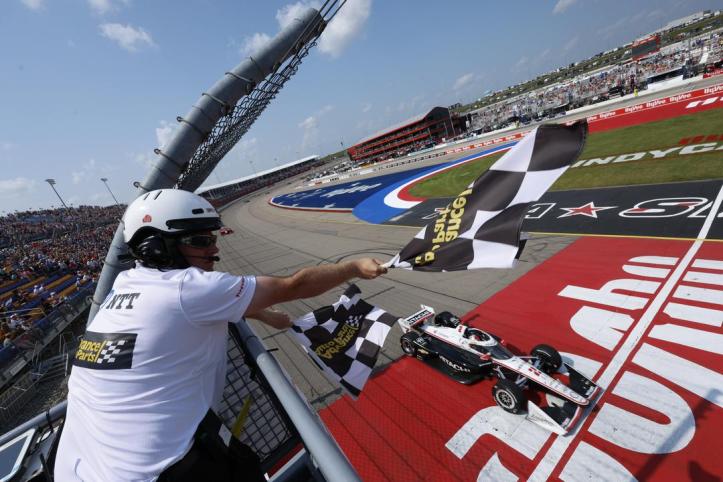
Between the yellow and green, INDYCAR also left the pits closed so no one could pit either. The only cars that came down pit road was the lappers so they could restart behind the five cars on the lead lap.
Both Will Power and Alex Palou were okay with the process because the precedent was set upfront in the drivers meeting.
“There weren’t enough laps left so I guess they were thinking,” second place finisher, Power said. “I think they said that in the driver meeting that with ten to go, they’re just going to — kind of it is what it is, which is quite interesting because it’s like — it would have been a big battle if it was new tires. A bit less with the old tires. Kind of close, but it still would have been a fun restart.”
The key there was it was said in the drivers meeting. It would be one thing if it was made up as they went, but that’s not the scenario here. INDYCAR had a plan and they stuck to it. I’m okay with that because if they said this plan, for which all parties said they did, it would be a farce if they went against it and red flagged it.
That would be a completely different story, but that’s not the case here.
INDYCAR wanted a green flag finish and that’s exactly what they got. They even had Laps 247 (coming to green), Lap 248, Lap 249 and Lap 250 all under green flag conditions.
“Yeah. Yeah, that’s how I understood it too. It seems to be the most fair way to — it’s such a short track,” Newgarden said of the drivers meeting with race control before the race itself.
“To procedurally do all the things that they want to do, just to give second, third, and so on place a chance at the end on a restart, I don’t like that, but I think if you’re looking at it from a fairness standpoint, if you’re going to let everyone have pit stops, then you have to — okay, we do that, but then we also have to move all the lap cars.
“I don’t think they have enough time on this length of the track. That’s the situation that happened in 2018, and we ran out — we thought we were going to go green, and we pitted, and we didn’t. We just ran out of time.
“I think the only way they can really approach this stuff is get the lap cars out of the way, we will go to the restart, and not allow anybody to pit. It’s probably the fairest thing can you do.
“I didn’t love it. I would have preferred to keep the lap cars in between. But looking at it from a competitor, I think it’s the fairest way they can approach it.”
I get his standpoint, but it’s also in the rule book that a caution within 20 laps to the finish puts all lapped cars behind the leaders. There’s no gray in that either.
Which is why it left some wondering why they didn’t allow the cars to pit for new tires and what kind of scenario would have ensued after.
If Newgarden pits from the lead, would the four behind follow suit? With only five cars on the lead lap, it would be worth the risk for a 3 lap shootout.
Or, if Newgarden didn’t pit, how many of the 4 behind would?
How much would fresh tires pay off?
“It would have been a really fun restart for me,” said third place finisher, Alex Palou. “Yeah, honestly I said it on the radio, if we were going to take tires or not. But it’s true that the lap is so short that — ten laps is nothing. Yeah, I think they did the right call.”
Newgarden says that it’s difficult to say whether he would have been able to hold everyone off on a late race restart with varying tire agendas, but he would like to think that he’d have been able to.
“The balance can get away from you really fast,’ he said. “I think we managed our balance perfectly at the time we needed to. We needed to do it for 250 laps. If it was longer, it was 300, maybe we would lose out to somebody else, but it’s impossible to say.”
Still, it’s a moot point because it didn’t happen and frankly, I don’t know if it could have.
You have Lap 241 to catch the pace car. Lap 242 to organize the running order. Lap 243-245 to clean up the crash. Lap 246 for the leaders to pit. Lap 247 for the lappers to pit. Lap 248 to bunch up. Lap 249 the 1 to go. Lap 250…it’s over.
So INDYCAR did the right thing. The best car won. The procedures were relayed on and precedent set before the race even began and the rules abided by.
While it’s different from Indy, I’m okay with it.
 Race Review Online