
Heading into Saturday’s qualifying session around the streets of Exhibition Place in Toronto, it was appearing that the pole for Sundays Honda Indy Toronto (1:30 p.m. ET, Peacock, IndyCar Radio Network) would go through the Andretti Autosport camp.
They went 1-2-4 during Friday’s practice as well as 1-2 on Saturday morning. It wasn’t that they were quick, it was that they were quick on both Firestone tire compounds too.
With 6 front row starting spots over the first 9 races to the season, including two straight, this was shaping up to be Andretti’s pole to lose.
Unfortunately for them, the laughable string of bad luck continued. This time, it was in the form of moisture.
None of the four cars would make it to the run at the pole in the Fast Six. Two of the drivers were even eliminated in the first round of qualifying at that. One of those two was last year’s pole sitter Colton Herta.
How? How does the driver who was quickest on Saturday morning, the one who won the last two NTT INDYCAR SERIES poles and was the pole sitter here a year ago relegated to a 14th place starting spot?
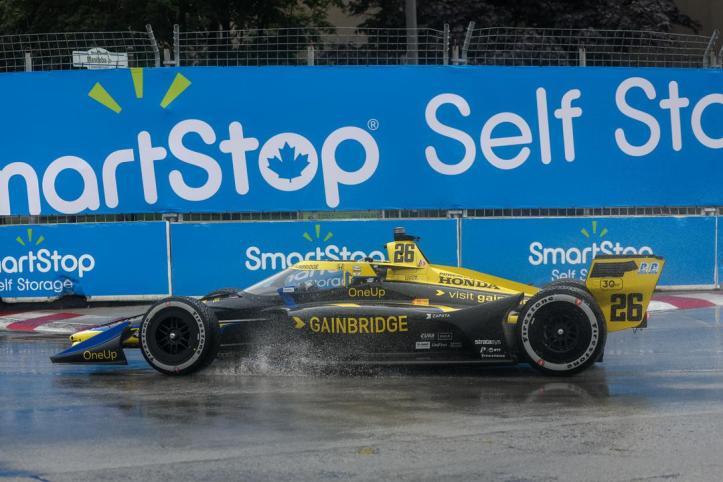
It came down to a decision made between practice and qualifying.
As the quickest driver on the combined speed chart, Herta was able to pick which group that he wanted to be in for qualifying. Most people may not fully understand the qualifying groups, but to take a deeper dive, they’re determined by the overall speed chart for the race weekend.
For this weekend in particular, we had a 75-minute practice session on Friday and a 60-minute practice session on Saturday. They take all the times from both sessions and order them 1-27. With Herta’s lap time on Saturday morning being P1, he had the choice.
So, everyone behind him that was odd on the speed charts (3rd, 5th, 7th, 9th, etc) would be in whatever group that Herta chooses. Everyone in 2nd, 4th, 6th, 8th, 10th and so on would be in the opposite group from Herta.
Between practice and qualifying, Herta chose Group 2. Which most drivers that are quickest do so because you get more grip on the track from the opening 12 minute group putting down rubber on the racing surface.
This time, it came back to bite them.
That’s because Herta’s car was so good in the dry conditions. He was fourth on Friday and first on Saturday. But rain is the great equalizer and sparked a messy second group. Which as a result, cost Herta a chance of shining and advancing on.
“We were definitely a lot better in the day than we were in the wet,” Herta said. “We seemed to just not have the rear end, struggled with wheelspin. I just couldn’t get the lap time down two what the other guys were doing.”
The thing is, I also wonder if getting this data in the wet on Saturday could make Herta even more dangerous on Sunday.
They were quickest on the Firestone primary tires and fourth on the alternates. So, if it’s a dry race, I wouldn’t count him out on coming through the field in the 85-lap race.
Then, if it rains, they now have data to make their cars better too.
“If it’s a rain race tomorrow, it’s good to get this bit of practice in, so maybe we can make some adjustments,” he said.
The one and only wet race in this Aeroscreen era, Herta won. He started…14th. Now, I get that you may say that’s on a natural road course. I get it.
However, in the 2021 season finale on the streets of Long Beach, Herta was surprisingly eliminated in the opening round of qualifying that day too. That didn’t stop him on race day. He would come through the field to win. His starting spot?
14th.
If you have a fast car, you have a fast car. You can pass. That’s why rain or shine, I’m not counting Herta out. An Indy Car season ebbs and flows. Herta’s team gave away a win on a pit call in Road America. He gave away a podium by speeding on pit lane the last time out in Mid-Ohio.
Can he use pit lane to win on Sunday via a pit call?
He has one coming…
 Race Review Online