
The rookie class for the NTT IndyCar Series last year was as advertised. We had the next potential great American driver in Colton Herta, a former Formula One driver (Marcus Ericsson) and under the radar Formula E/Indy Lights driver (Felix Rosenqvist) and a rising American star overseas that was blackballed over there (Santino Ferrucci).
They lived up to expectations and more.
Rosenqvist and Herta had an intense season long battle for Rookie of the Year Honors as both finished sixth and seventh respectively as first year drivers in arguably the most talented racing field from top to bottom in the world.
Ferrucci surprisingly made this rookie class one of the best in recent history. He of all people, in a Dale Coyne Racing car, won Rookie of the Year Honors for the Indianapolis 500. He drew praise from Dale Earnhardt Jr. in doing so. He made bold moves and was quick on ovals.
Ericsson, having not seen any of these tracks before other than COTA, got faster and faster as the year went on.
Now, if all four are going to shine in their sophomore seasons, Herta and Rosenqvist note that getting more comfortable on ovals are going to be the areas they can grow the most in order to move up in the standings, while Ferrucci wants to get better on street courses.
“I think going to Texas is going to be cool because my biggest improving thing from last year is definitely ovals,” Rosenqvist, last year’s Rookie of the Year, said. “That’s been a thing I’ve been thinking mostly about during the off-season. I think I have more to gain than anything else.
“Starting off in Texas, it’s going to be a nice feeling to see how much of that work has paid off, where we sort of stand compared to the others, especially on the ovals and superspeedways straight off the bat in the beginning of the year. Yeah, it’s going to be fun.”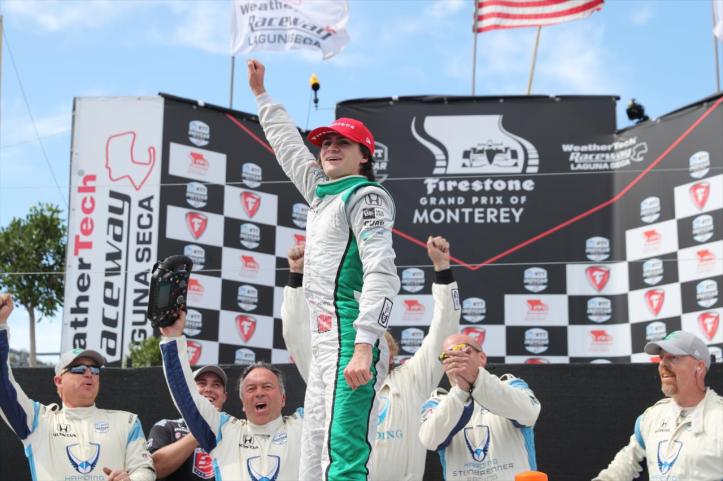
Herta, 20, agreed saying that not just all ovals, it was short ovals which were his problem areas in 2019.
“Yeah, for sure,” Herta said when asked if ovals are the spot to improve the most for 2020. “I think that’s probably the — not really all ovals, but definitely, the short ovals is what I struggled on most. It’s probably the least amount of experienced one, too, so I think still learning a little bit in that department. Obviously I’ve got some good guys because Alex is good and especially Ryan is really good at all of the short ovals.
“We have good data there. I think we’ve improved the cars over the off-season in places like Gateway and Iowa where I think we struggled last year compared to Ganassi and Penske, but yeah, also I’ve learned a lot, and yeah, I think just taking everything in that we learned last year, not from the car but from the driving itself and really just the race prep for me I think I’ll be very well prepared going into this year on all the ovals.”
See, everywhere else, the young rookies shined. Herta, the American phenom won in just his third career NTT IndyCar Series start at the Circuit Of The Americas last March. The second generation driver then wowed us in qualifying for the Indianapolis 500. He not only made the Fast Nine, he’d qualify his No. 88 Honda fifth. While he went through a rough patch in the middle portion of the schedule, he picked up consistency later on which saw him end 2019 in victory lane in the season finale at Laguna Seca — his second victory in his first full time year in the series. He actually ended with six top 10 finishes in his last eight starts overall and narrowly missed out on Rookie of the Year Honors.
Now, he moves to fully under the Andretti Autosport banner as the fifth entry in 2020. The pressure grows. In an Andretti car during his sophomore campaign with one of IndyCar’s top teams, he’s going to be expected to grow even more. How do you grow from two wins as a rookie to a better year in year 2? Oh yeah, you have to do so in the middle of a global pandemic which wiped out the first nine races of the season.
“I think just excited,” Herta said on Wednesday about the upcoming season. “I think a lot of us, this is the longest that we’ve ever been out of the car, especially for me. And so yeah, it’s been really tough, but like everyone said, I think we’re all really excited to get back, and we’re all really excited that we’re doing it in a safe way. Sucks that we don’t have the fans, but at least we get to go racing and put on a show for everyone on TV.”
His oval finishes last year were 33rd (Indy 500), 18th (Texas), 18th (Iowa), 16th (Pocono) and ninth (Gateway) respectively. The only time he didn’t finish in the top 10 from Texas on last year were on ovals.
First up in 2020? An oval. A high speed oval at the Texas Motor Speedway. It’s going to be a difficult place to get going when these guys haven’t even been in a race car since February. The last race was last September. Now, with just a couple of hours of practice in length on Saturday, they have to race after.
“I think it is a very tough place to start,” Herta noted. “Obviously going from zero miles an hour for a very long time to 230, 220 is very difficult. But with that being said, I think it’s going to be more about getting all the unknowns out, like they covered kind of the COP, the aerodynamics of the car, the weight distribution that the aero screen changes.
“And I think it’s actually going to be a very interesting race. I think with these 35-lap stints, it can open for more rubber going down on the track and can open up a second lane possibly and make the track grippier so we can follow closer and hopefully get more passing in. So I don’t think this 35-lap stint thing is terrible news like I think a lot of people think.”
Rosenqvist’s finishes on ovals in 2019 were similar. He had 10 top 10 finishes in 17 overall tries. The problem was, all 10 were on road or street courses. In the five oval races, he finished 28th (Indianapolis), 12th (Texas), 14th (Iowa), 22nd (Pocono) and 11th (Gateway). If he wants to contend for this year’s championship, he has to turn those results into top 10’s, if not top fives.
While not all the problems on ovals were his fault, as his veteran teammate Scott Dixon noted, Dixon says that ovals are a spot Ganassi tried to improve upon for 2020 too.
“It’s definitely one of the focuses,” Dixon said on oval development for Ganassi in the offseason. “I think Texas we were running second when we got into the accident towards the end of the race. We were second. We had a mechanical failure at St. Louis with the radiator leak.
“I think really our biggest downfall last year was Indianapolis. Our race pace was decent. We weren’t just that good in traffic and qualifying was pretty horrendous.”
Dixon, noted that the addition of a third car for 2020 and the closure of the IMSA program could help speed up that boost on ovals now too.
“I think we’ve worked a lot on our deficits from last year,” Dixon continued. “I think with what we’ve been able to do with adding Marcus (Ericsson) to the fold has created a lot of opportunity with new people coming into the mix, plus more engineering staff from the Ford GT program which has been huge in the off-season to try to process some things, try to fix some of the issues.
“I guess we’ll just have to wait and see. I think we’ve made some good progression. I think having two great teammates that have had some good miles on ovals to try to help the process of these short practice sessions, to get on top of it, it’s going to be big for us as a whole.
“Yeah, lots of positives we see. We have to really wait till we get to the real world and get to the race, see how that plays out.”
So, if both Herta and Rosenqvist get better on ovals and remain the same on road/street courses, then watch out.
In Ericsson’s case, he moves to Chip Ganassi Racing from Schmidt Peterson. Ericsson, says that he expects better results too as this will be his second time through the schedule.
“I mean, for me everything was new last year,” said Ericsson on a zoom call on Monday after scoring just three top 10 finishes in 16 tries last season. “It was a complete new series. All the tracks were new, the cars, everything. It was a very steep learning curve for me. I felt throughout the year I was progressing, sort of getting into it more and more.
“I think one of the biggest things that I found with INDYCAR is just the way you have to be complete as a driver because we go to so many different types of tracks. It’s everything from short ovals to superspeedways to street tracks to sweeping road courses. You need to be a complete driver to be competitive in this series.
“Also talking about competitive, the competition in this series is extremely high. That’s also something I found last year, that one small mistake and you’re down towards the bottom of the field. You need to get everything right, get the car set up well, then really maximize in qualifying and the race.”
What excites Ericsson about 2020 isn’t necessarily joining a new team at Chip Ganassi Racing, one of IndyCar’s premiere teams, it’s that he’s getting to see these tracks a second time around. I mean, just look at Belle Isle last year as a prime example. That’s the only track that he got to see twice in a single season. He finished 13th in the first race but came back the next day for a seasons best runner-up effort.
Now, there’s no new tracks to learn for 2020. They’re all the same.
“Mainly for me, learning all the tracks and knowing all the tracks now going into my second year is going to be huge,” said Ericsson. “Also joining a team like Chip Ganassi Racing is obviously a massive opportunity for me to work with Scott Dixon, obviously Felix, two of the best drivers in the field. It’s also going to be really good for me to try to learn as much as possible from them, as well.
“I really hope and think that I can show a lot more this year in my second year. Yeah, looking forward to finally starting the season and show that for everyone.”
For Ferrucci, his team went through a lot of changes. He’s in a different car, replacing Sebastien Bourdais. He has a new teammate in a rookie (Alex Palou) who’s never driven an IndyCar before. Also, both engineers are gone as well. Despite that, Ferrucci is dreaming big and thinks that his No. 18 Honda can contend for wins on the five oval stops this season, including Saturday night’s race.
“No, I think it’s definitely realistic to fight for wins on ovals,” Ferrucci said. “Obviously a championship is full of all sorts of variables. You have still massive teams with big budgets that will be up throughout the winter and throughout this extra time during extra prep and have different tools, but I do think that we will be in contention for a championship this year.
“It’s just about playing our cards right, and like you said there, there are five ovals this year, and obviously for the statistics there are technically more oval races to street and road courses, but with that, we are missing a lot of street course races, which I did enjoy and I did think we were very competitive with. So we’re really focused in on our road course program to make sure that that is in the best shape possible for when we do get to those double headers.”
While the loss of the engineers is huge, Ferrucci noted that both did a lot of prep work for 2020 before they left though.
“I mean, obviously with the loss of Cannon going to Ganassi and then obviously losing Craig was really tough, but they did a lot of work for us before leaving, especially Craig,” Ferrucci continued. “He did finish up a lot of our Indy 500 stuff that was on his plate going in throughout the winter, which I can’t thank him enough for. It was a huge stress load off the team. But with Olivier leading, I have a lot of faith in him. He is incredibly intelligent and he’s probably one of the best I’ve ever seen and I’ve come across. So I think we’ll be in really good hands.”
 Race Review Online